
Jose Marti
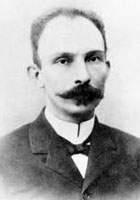

Jose Marti Poems
I have a white rose to tend
In July as in January;
I give it to the true friend
Who offers his frank hand to me.
...
I wish to leave the world
By its natural door;
In my tomb of green leaves
They are to carry me to die
...
¡Dolor! ¡Dolor! eterna vida mía,
Ser de mi ser, sin cuyo aliento muero!
...
Day and night
I always dream with open eyes
And on top of the foaming waves
Of the wide turbulent sea,
...
Una cita a la sombra de tu oscuro
Portal donde el friecillo nos convida
A apretarnos los dos, de tan estrecho
...
Llegada la hora del trabajo
¡Ea, jamelgo! De los montes de oro
Baja, y de andar en prados bien olientes
...
Qué importa que tu puñal
Se me clave en el riñón?
¡Tengo mis versos, que son
Más fuertes que tu puñal!
Qué importa que este dolor
Seque ...
...
Aquí estoy, solo estoy, despedazado.
Ruge el cielo: las nubes se aglomeran,
Y aprietan, y ennegrecen, y desgajan:
...
I who live though I have died,
Claim a great discovery,
For last night I verified
Love is the best remedy.
...
¿Palabras? ya sé, palabras,
No me las puedes decir;
Pero mirarme sí puedes:—
...
No sientas que te falte
el don de hablar que te arrebata el cielo,
no necesita tu belleza esmalte
...
I'll never forget, I vow,
That fall morning long ago,
When I saw a new leaf grow
Upon the old withered bow.
...
If you've seen a mount of sea foam,
It is my verse you have seen:
My verse a mountain has been
And a feathered fan become.
...
I'm so frightfully unhappy,
I feel, oh stars, I am dying!:
I want to live, and I'm sighing
A beauteous woman to see.
...
If I a pleasant keepsake
On leaving this world may bear,
Father profound, I would take
A lock of your silver hair.
...
I have come to the strange ball
Where tails and gaiters abound,
And the best hunters the year-round
The New Year wait to install.
...
I have a page of loyal-renown
Who bends to all my desires,
Takes care of me, never tires,
Cleans and shines my laurel clown.
...
I have a page of loyal-renown
Who bends to all my desires,
Takes care of me, never tires,
Cleans and shines my laurel clown.
...
I wish to leave the world
By its natural door;
In my tomb of green leaves
They are to carry me to die.
Do not put me in the dark
To die like a traitor;
I am good, and like a good thing
I will die with my face to the sun
...
De mi desdicha espantosa
Siento, oh estrellas, que muero:
Yo quiero vivir, yo quiero
Ver a una mujer hermosa.
El cabello, como un casco,
Le corona el rostro bello:
Brilla su negro cabello
Como un sable de Damasco.
¿Aquélla?... Pues pon la hiel
Del mundo entero en un haz,
Y tállala en cuerpo, y ¡haz
Un alma entera de hiel!
¿Esta?... Pues esta infeliz
Lleva escarpines rosados,
Y los labios colorados,
Y la cara de barniz.
El alma lúgubre grita:
'¡Mujer, maldita mujer!'
¡No sé yo quién pueda ser
Entre las dos la maldita!
...
Jose Marti Biography
José Julián Martí Pérez (January 28, 1853 – May 19, 1895) was a Cuban national hero and an important figure in Latin American literature. In his short life he was a poet, an essayist, a journalist, a revolutionary philosopher, a translator, a professor, a publisher, and a political theorist. Through his writings and political activity, he became a symbol for Cuba's bid for independence against Spain in the 19th century, and is referred to as the "Apostle of Cuban Independence." He also fought against the threat of United States expansionism into Cuba. From adolescence, he dedicated his life to the promotion of liberty, political independence for Cuba and intellectual independence for all Spanish Americans; his murder was used as a cry for Cuban independence from Spain by both the Cuban revolutionaries and those Cubans previously reluctant to start a revolt. Born in Havana, Martí began his political activism at a young age. He would travel extensively in Spain, Latin America, and the United States raising awareness and support for the cause of Cuban independence. His unification of the Cuban émigré community, particularly in Florida, was crucial to the success of the Cuban War of Independence against Spain. He was a key figure in the planning and execution of this war, as well as the designer of the Cuban Revolutionary Party and its ideology. He died in military action on May 19, 1895. Martí is considered one of the great turn-of-the-century Latin American intellectuals. His written works consist of a series of poems, essays, letters, lectures, a novel, and even a children's magazine. He wrote for numerous Latin American and American newspapers; he also founded a number of newspapers himself. His newspaper Patria was a key instrument in his campaign for Cuban independence. After his death, one of his poems from the book, "Versos Sencillos" (Simple Verses) was adapted to the song, "Guantanamera," which has become the definitive patriotic song of Cuba. The concepts of freedom, liberty, and democracy are prominent themes in all of his works, which were influential on the Nicaraguan poet, Rubén Darío and the Chilean poet, Gabriela Mistral. Martí's style of writing is difficult to categorize. He used many aphorisms - short, memorable lines that convey truth and/or wisdom - and long complex sentences. He is considered a major contributor to the Spanish American literary movement known as Modernismo and has been linked to Latin American consciousness of the modern age and modernity. His chronicles combined elements of literary portraiture, dramatic narration, and a dioramic scope. His poetry contained "fresh and astonishing images along with deceptively simple sentiments". As an orator (for he made many speeches) he was known for his cascading structure, powerful aphorisms, and detailed descriptions. More important than his style is how he uses that style to put into service his ideas, making "advanced" convincing notions. Throughout his writing he made reference to historical figures and events, and used constant allusions to literature, current news and cultural matters. For this reason, he may be difficult to read and translate. His didactic spirit encouraged him to establish a magazine for children, La Edad de Oro (1889) which contained a short essay titled "Tres Heroes" (three heroes), representative of his talent to adapt his expression to his audience; in this case, to make the young reader conscious of and amazed by the extraordinary bravery of the three men, Bolivar, Hidalgo, and San Martín. This is his style to teach delightfully.)
The Best Poem Of Jose Marti
I Have A White Rose To Tend (Verse Xxxix)
I have a white rose to tend
In July as in January;
I give it to the true friend
Who offers his frank hand to me.
And for the cruel one whose blows
Break the heart by which I live,
Thistle nor thorn do I give:
For him, too, I have a white rose.
CULTIVO UNA ROSA BLANCA... (Verso XXXIX)
Cultivo una rosa blanca,
En julio como en enero,
Para el amigo sincero
Que me da su mano franca.
Y para el cruel que me arranca
El corazón con que vivo,
Cardo ni oruga cultivo:
Cultivo la rosa blanca.
Jose Marti Comments


Delivering Poems Around The World
Poems are the property of their respective owners. All information has been reproduced here for educational and informational purposes to benefit site visitors, and is provided at no charge...
10/20/2026 5:01:46 AM # rel_20260925T122446Z_7d6ee41


I want to follow his ethic in my life. It was a real ethic to be followed: helping the weak people and trying to do what is real justice always.