
Thomas Gray
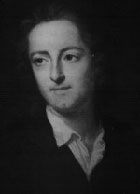

Thomas Gray Poems
The Curfew tolls the knell of parting day,
The lowing herd wind slowly o'er the lea,
The plowman homeward plods his weary way,
And leaves the world to darkness and to me.
...
'Twas on a lofty vase's side,
Where China's gayest art had dy'd
The azure flow'rs that blow;
Demurest of the tabby kind,
The pensive Selima, reclin'd,
Gazed on the lake below.
...
'Ruin seize thee, ruthless King!
Confusion on thy banners wait,
Tho' fanned by Conquest's crimson wing
They mock the air with idle state.
...
Awake, Aeolian lyre, awake,
And give to rapture all thy trembling strings.
From Helicon's harmonious springs
A thousand rills their mazy progress take:
...
Lo! where the rosy-bosom'd Hours,
Fair Venus' train appear,
Disclose the long-expecting flowers,
And wake the purple year!
The Attic warbler pours her throat,
...
Now the storm begins to lower,
(Haste, the loom of Hell prepares!)
Iron-sleet of arrowy shower
Hurtles in the darkened air.
...
Ye distant spires, ye antique towers,
That crown the watry glade,
Where grateful ScienceÊ still adores
Her Henry'sÊ holy shade;
And yeÊ that from the stately brow
...
In vain to me the smiling mornings shine,
And redd'ning Phoebus lifts his golden fire:
The birds in vain their amorous descant join;
Or cheerful fields resume their green attire:
...
Daughter of Jove, relentless Power,
Thou tamer of the human breast,
Whose iron scourge and tort'ring hour
The Bad affright, afflict the Best!
...
1 In vain to me the smiling Mornings shine,
2 And reddening Phœbus lifts his golden fire;
3 The birds in vain their amorous descant join;
...
Now the golden Morn aloft
Waves her dew-bespangled wing,
With vermeil cheek, and whisper soft
She woos the tardy Spring:
...
WEAVE the warp, and weave the woof,
The winding-sheet of Edward's race.
Give ample room, and verge enough
The characters of hell to trace.
...
If I should die and leave you
Be not like the others, quick undone
Who keep long vigils by the silent
dust and weep.
...
Here, freed from pain, secure from misery, lies
A child, the darling of his parents' eyes:
A gentler lamb n'er sported on the plain,
A fairer flower will never bloom again:
...
Thomas Gray Biography
Gray's father was a scrivener while his mother and aunt kept a milliner's shop. He led a quiet, studious life in the main, training in law after his degree at Cambridge and then becoming a history done at Peterhouse. Gray formed a friendship with Walpole which was broken off as a result of a disagreement during a "Grand Tour of Europe" (1734-39), though they were eventually reconciled in 1745. This friendship was important to Gray's literary career and Walpole later published The Progress of Poetry and The Bard, an impassioned summary of English history, on his Strawberry Hill Press. Gray sent his Ode on the Spring to an Etonian friend, Richard West, who died shortly afterwards, prompting the Sonnet on the Death of West. Gray was immensely popular and helped to create a new taste in poetry; fertile ground for the romantic poets to follow him. In 1757 at the death of the Poet Laureate Cibber, the post was offered to Gray, but he refused it.)
The Best Poem Of Thomas Gray
Elegy Written In A Country Churchyard
The Curfew tolls the knell of parting day,
The lowing herd wind slowly o'er the lea,
The plowman homeward plods his weary way,
And leaves the world to darkness and to me.
Now fades the glimmering landscape on the sight,
And all the air a solemn stillness holds,
Save where the beetle wheels his droning flight,
And drowsy tinklings lull the distant folds;
Save that from yonder ivy-mantled tow'r
The moping owl does to the moon complain
Of such as, wand'ring near her secret bow'r,
Molest her ancient solitary reign.
Beneath those rugged elms, that yew-tree's shade,
Where heaves the turf in many a mould'ring heap,
Each in his narrow cell for ever laid,
The rude Forefathers of the hamlet sleep.
The breezy call of incense-breathing Morn,
The swallow twitt'ring from the straw-built shed,
The cock's shrill clarion, or the echoing horn,
No more shall rouse them from their lowly bed.
For them no more the blazing hearth shall burn,
Or busy housewife ply her evening care:
No children run to lisp their sire's return,
Or climb his knees the envied kiss to share.
Oft did the harvest to their sickle yield,
Their furrow oft the stubborn glebe has broke:
How jocund did they drive their team afield!
How bow'd the woods beneath their sturdy stroke!
Let not Ambition mock their useful toil,
Their homely joys, and destiny obscure;
Nor Grandeur hear with a disdainful smile
The short and simple annals of the poor.
The boast of heraldry, the pomp of pow'r,
And all that beauty, all that wealth e'er gave,
Awaits alike th' inevitable hour:
The paths of glory lead but to the grave.
Nor you, ye Proud, impute to These the fault,
If Memory o'er their Tomb no Trophies raise,
Where through the long-drawn aisle and fretted vault
The pealing anthem swells the note of praise.
Can storied urn or animated bust
Back to its mansion call the fleeting breath?
Can Honour's voice provoke the silent dust,
Or Flatt'ry soothe the dull cold ear of death?
Perhaps in this neglected spot is laid
Some heart once pregnant with celestial fire;
Hands, that the rod of empire might have sway'd,
Or waked to ecstasy the living lyre.
But Knowledge to their eyes her ample page
Rich with the spoils of time did ne'er unroll;
Chill Penury repress'd their noble rage,
And froze the genial current of the soul.
Full many a gem of purest ray serene
The dark unfathom'd caves of ocean bear:
Full many a flower is born to blush unseen,
And waste its sweetness on the desert air.
Some village Hampden that with dauntless breast
The little tyrant of his fields withstood,
Some mute inglorious Milton here may rest,
Some Cromwell guiltless of his country's blood.
Th' applause of list'ning senates to command,
The threats of pain and ruin to despise,
To scatter plenty o'er a smiling land,
And read their history in a nation's eyes,
Their lot forbade: nor circumscribed alone
Their glowing virtues, but their crimes confined;
Forbade to wade through slaughter to a throne,
And shut the gates of mercy on mankind,
The struggling pangs of conscious truth to hide,
To quench the blushes of ingenuous shame,
Or heap the shrine of Luxury and Pride
With incense kindled at the Muse's flame.
Far from the madding crowd's ignoble strife,
Their sober wishes never learn'd to stray;
Along the cool sequester'd vale of life
They kept the noiseless tenor of their way.
Yet ev'n these bones from insult to protect
Some frail memorial still erected nigh,
With uncouth rhymes and shapeless sculpture deck'd,
Implores the passing tribute of a sigh.
Their name, their years, spelt by th' unletter'd muse,
The place of fame and elegy supply:
And many a holy text around she strews,
That teach the rustic moralist to die.
For who, to dumb Forgetfulness a prey,
This pleasing anxious being e'er resign'd,
Left the warm precincts of the cheerful day,
Nor cast one longing ling'ring look behind?
On some fond breast the parting soul relies,
Some pious drops the closing eye requires;
Ev'n from the tomb the voice of Nature cries,
Ev'n in our Ashes live their wonted Fires.
For thee, who, mindful of th' unhonour'd dead,
Dost in these lines their artless tale relate;
If chance, by lonely contemplation led,
Some kindred spirit shall inquire thy fate,
Haply some hoary-headed Swain may say,
'Oft have we seen him at the peep of dawn
Brushing with hasty steps the dews away
To meet the sun upon the upland lawn.
'There at the foot of yonder nodding beech
That wreathes its old fantastic roots so high,
His listless length at noontide would he stretch,
And pore upon the brook that babbles by.
'Hard by yon wood, now smiling as in scorn,
Mutt'ring his wayward fancies he would rove,
Now drooping, woeful wan, like one forlorn,
Or crazed with care, or cross'd in hopeless love.
'One morn I miss'd him on the custom'd hill,
Along the heath and near his fav'rite tree;
Another came; nor yet beside the rill,
Nor up the lawn, nor at the wood was he;
'The next with dirges due in sad array
Slow through the church-way path we saw him borne.
Approach and read (for thou canst read) the lay
Graved on the stone beneath yon aged thorn:'
THE EPITAPH
Here rests his head upon the lap of Earth
A Youth to Fortune and to Fame unknown.
Fair Science frown'd not on his humble birth,
And Melancholy mark'd him for her own.
Large was his bounty, and his soul sincere,
Heav'n did a recompense as largely send:
He gave to Mis'ry all he had, a tear,
He gain'd from Heav'n ('twas all he wish'd) a friend.
No farther seek his merits to disclose,
Or draw his frailties from their dread abode,
(There they alike in trembling hope repose,)
The bosom of his Father and his God.
Thomas Gray Comments
My comments are more on the poem, 'Ode on the Death of a Favourite Cat' than on thomas Gray.(who also wrote 'Elegy Written in a Cpuntry Churchyard') . The Ode is a beautifully sad poem that yet manages to be delightfully comical through its use of language: It has some of the qualities of mock epic poetry in which the trivial is elevated to the near-grand. The cat is elevated to near human status by such words as 'reclined', 'beard', 'purred applause, 'nymph', and 'presumotuous maid''. Similarly the goldfish are elevated to grander status by such descriptions as 'angel forms', 'genii of the stream' and 'scaly armour'. Even the goldfish bowl is seen comically as containing a 'lake', 'tide', 'stream' and 'flood' which is further elevated by being imagined to contain such mythical entities as a 'watery god' (Neptune? !) , Nereids - and a dolphin! Even Fate is imagined as a cruel god causing the tragedy and smiling as it occurs. The moral that all that appears attractive is not to be trusted is comically and teasingly sexist: 'ye beauties' are to beware of the temptations of (presumably male?) flesh. For me this is favourite comic poem.
Thomas Gray Popularity
Thomas Gray Popularity


Delivering Poems Around The World
Poems are the property of their respective owners. All information has been reproduced here for educational and informational purposes to benefit site visitors, and is provided at no charge...
4/27/2024 6:30:22 AM # 1.0.0.1119


Good poems