
A Summer Afternoon Poem by James Whitcomb Riley
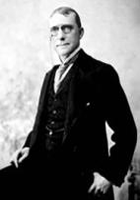

A Summer Afternoon
A languid atmosphere, a lazy breeze,
With labored respiration, moves the wheat
From distant reaches, till the golden seas
Break in crisp whispers at my feet.
My book, neglected of an idle mind,
Hides for a moment from the eyes of men;
Or lightly opened by a critic wind,
Affrightedly reviews itself again.
Off through the haze that dances in the shine
The warm sun showers in the open glade,
The forest lies, a silhouette design
Dimmed through and through with shade.
A dreamy day; and tranquilly I lie
At anchor from all storms of mental strain;
With absent vision, gazing at the sky,
"Like one that hears it rain."
The Katydid, so boisterous last night,
Clinging, inverted, in uneasy poise,
Beneath a wheat-blade, has forgotten quite
If "Katy DID or DIDN'T" make a noise.
The twitter, sometimes, of a wayward bird
That checks the song abruptly at the sound,
And mildly, chiding echoes that have stirred,
Sink into silence, all the more profound.
And drowsily I hear the plaintive strain
Of some poor dove . . . Why, I can scarcely keep
My heavy eyelids--there it is again--
"Coo-coo!"--I mustn't--"Coo-coo!"--fall asleep!
A Summer Afternoon by James Whitcomb Riley begins stanza one with ‘A languid atmosphere, a lazy breeze, With labored respiration, ’ and these lines accurately describe the heat and sets up well; the inability of this person to study, on this hot summer afternoon. The subject seems a poor reluctant student. ‘My book, neglected of an idle mind, Hides for a moment from the eyes of men; Or lightly opened by a critic wind, Affrightedly reviews itself again.’ The attempted study is halfhearted, an ‘idle mind’ apparently ‘Hides for a moment from the eyes of men; ’ and this seems to indicate that study upon this books topic is necessary and expected. The personification of ‘a critic wind, ’ in juxtaposition with ‘Affrightedly reviews itself again’, creates a tense; a sudden overwhelming fear of the book’s subject matter is indicated. Perhaps the topic is law which Riley attempted to study but found himself unsuited for in his ‘father’s law office’. Riley like many of us had difficulties when applying himself to study and was not a gifted student. ‘At anchor from all storms of mental strain; With absent vision, builds upon a discord between peaceful harmonic nature and the students lacking insight in his studies. ‘And drowsily I hear the plaintive strain’ is like a plea for rest, from studied mental anguish, puns a contrast between laws of nature and requirements of human society. The final line ‘'Coo-coo! '-I mustn't-'Coo-coo! '-fall asleep! ’ reminds of the eventual result of many study attempts, and the natural lullaby of a hot summer’s day. Beautiful imagery, Riley is a gifted poet.
The first stanza is, indeed, a perfect set-up, with the push-pull tension of the words 'languid, lazy' versus 'labored, moves'.
One summer I spent long lazy days on the river not far from the site of the Riley residence in downstate Indiana. Supplied with a can of nightcrawlers I'd procured from my uncle's backyard and with a volume of Riley's verses I set up my cane pole and leaned against a tree on the river bank. Fish weren't biting, so I opened the book and read and before I knew it I was deep in a Hoosier dream of the old days when Riley and his band of school drop-outs roamed the countryside painting and sky-larking. I didn't care at all if Katy DID or DIDN'T make a noise. Twittering birds lulled this city kid... asleep!
The smell of garlic may make the fruit taste strange. //xn--o80b910a26eepc81il5g.vom77.com 카지노사이트
Absolutely beautiful. Each and every word sprayed a mist of tranquility like a sprinkler in hot summer.
Absolutely gorgeous. Brought visions is tranquility and just sheer self moments. I adore this so much! ! !
This poem has not been translated into any other language yet.
I would like to translate this poem


Delivering Poems Around The World
Poems are the property of their respective owners. All information has been reproduced here for educational and informational purposes to benefit site visitors, and is provided at no charge...
5/16/2026 9:39:55 PM # 1.0.0


I know exactly what he means - he captured one of my most significant landscapes. Mr. Pruchnicki, that's exactly what I think! What a wonderful experience that must have been!