
A Cooking Egg Poem by Thomas Stearns Eliot
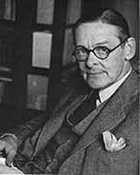

A Cooking Egg
The text of this poem could not be published because of Copyright laws.
The first two lines are a quotation from a ballad by the medieval French writer François Villon. Roughly translated ' In this thirtieth year of my life/ I have already drunk deeeply of shame' Although this is one of his more approachable pieces a later part of the poem contains one of Eliot's more notorious anti-semitic outbursts 'The red-eyed scavengers are creeping/ From Kentish Town and Golders Green'. Golder Green is of course a predominantly Jewish area of London. Eliot is also showing his distaste for the proletariat here. Personally I think it is time Eliot's reputation as a poet was revised - he was certainly strongly tinged with facism - and I won't be including him in my top fifty unless it's for one of the Cat poems. It's very debatable also whether one should have to read a poem with several encyclopedias on the chair arm in order to understand them. I think Eliot was wrong also in any case to think that the West had 'forgotten' the great classical writers and in any case I see no evidence that his work has created a resurgence of interest. At the very least poetry was entering a blind alley by becoming so abstruse. Of course in much of his writing Eliot shields behind a persona (as here) but there's no real doubt that much of it is autiobiographical.
How marvellous is poetry. I find this poem neither powerful nor depressing. It is, however, full of irony, considering Eliot's first marriage, and I wonder whether there had been a recent production of Shaw's Arms and the Man. It is probably dangerous to attribute too many autobiographical musings to Eliot. For instance, only his waistcoat and spectacles could have belonged to J. Alfred Prufrock. I can see 'Pipit', a gray drab bird, saying, 'Whatever do you mean? You have the soul of an English teacher', while his American family chimes in saying, 'This poetry thing has made you make no sense at all, no sense at all.'
After Robert Browning, Matthew Arnold and T S Eliot are cherished most in English poetry. But both Arnold and Eliot are remembered mostly as literary critics only more than their poetry or plays! A Cooking Egg is something strange to hear apart from his famous Waste Land! Symbolically it means blockage of growth at the birth itself! It is better to make the best of what we have in life than to chase after the dream! As for me he is only a critic like Arnold and nothing else! A Cooking Egg is true as far as his position is concerned!
Bombastic was another nice word you could have used Michael. In the age of the stone age typewriter, when references and translations were not but a word search away, Eliot in foreign language was a problem if scholastic or detailed understanding was sort. An esteemed company to be included among, and a compliment to learning earnestly sort. Alexander Pope expressed such requisite learning best do you think? A little learning is a dangerous thing; Drink deep, or taste not the Pierian spring: There shallow draughts intoxicate the brain, And drinking largely sobers us again.
How does one contest the erudite opinions expressed at such tedious length by writers Craddock, Graham and Fraser? Dare I say all three have been afflicted with hyperbolic logorrhea in a stilted tongue?
Interesting comments all. Funny while studying English Lit I was never informed who the three most cherished poets in English poetry were. Although after studying American, English, Australian, and New Zealand Poetry predominantly but not exclusively; and Medieval English Literature, Renaissance Poetry & Prose, Romantic Poetry & Prose, Augustan Poetry & Prose, Victorian Poetry & Prose and Twentieth Century Poetry; I personally believe this to be a statement that cannot be qualified. Eliot’s ‘A Cooking Egg’ has been claimed as American Poetry so let ‘The Wasteland’ remain English European, or not if you feel so strongly about the issue. Eliot’s use of Latin, Greek, French, and German used directly in his poetry to make important comments without translation, is frustrating and dare I say snobbish. A translation footnoted or referenced at the back of a volume is both polite and necessary. A basic knowledge of Myth & Literature, Greek & Roman Literature, The Novel in various periods is usually a help with the classical poets, sooner or later. More importantly enjoy and read them as you like. That is after all the purpose of poetry. So ‘PIPIT sate upright in her chair’, seems they argued a lot. She is a homely girl, ‘with the knitting’. Perhaps if Eliot is rather a self confessed cad, he should not have married a woman of family tradition and orientation, with so many family photographs ‘Supported on the mantelpiece’. The type of woman he preferred is attested to with ‘I shall not want Society in Heaven, Lucretia Borgia shall be my Bride’. With her documented incestuous relationship and the Borgia reputation, truth or myth, one wonders did she really make it to heaven or not. Being the daughter in-law of a Pope probably helps though. No I a not knocking the Roman Catholic Church, I have great respect for my cousin Father John, due to the fact it is warranted. These were a different era in Papal Diplomacy, and the poem is an intriguing read, worth the effort of looking it up on a different web site.
Why doe's my screen say text of poem can not be published because of copyright laws? ? ? ? ? ? ?
This poem has not been translated into any other language yet.
I would like to translate this poem


Delivering Poems Around The World
Poems are the property of their respective owners. All information has been reproduced here for educational and informational purposes to benefit site visitors, and is provided at no charge...
6/5/2026 7:45:30 AM # 1.0.0


The first two lines are a quotation from a ballad by the medieval French writer François Villon. Roughly translated ' In this thirtieth year of my life/ I have already drunk deeeply of shame' Although this is one of his more approachable pieces a later part of the poem contains one of Eliot's more notorious anti-semitic outbursts 'The red-eyed scavengers are creeping/ From Kentish Town and Golders Green'. Golders Green is of course a predominantly Jewish area of London. Eliot is also showing his distaste for the proletariat here. Personally I think it is time Eliot's reputation as a poet was revised - he was certainly strongly tinged with facism - and I won't be including him in my top fifty unless it's for one of the Cat poems. It's very debatable also whether one should have to read a poem with several encyclopedias on the chair arm in order to understand them. I think Eliot was wrong also in any case to think that the West had 'forgotten' the great classical writers and in any case I see no evidence that his work has created a resurgence of interest. At the very least poetry was entering a blind alley by becoming so abstruse. Of course in much of his writing Eliot shields behind a persona (as here) but there's no real doubt that much of it is autiobiographical.